

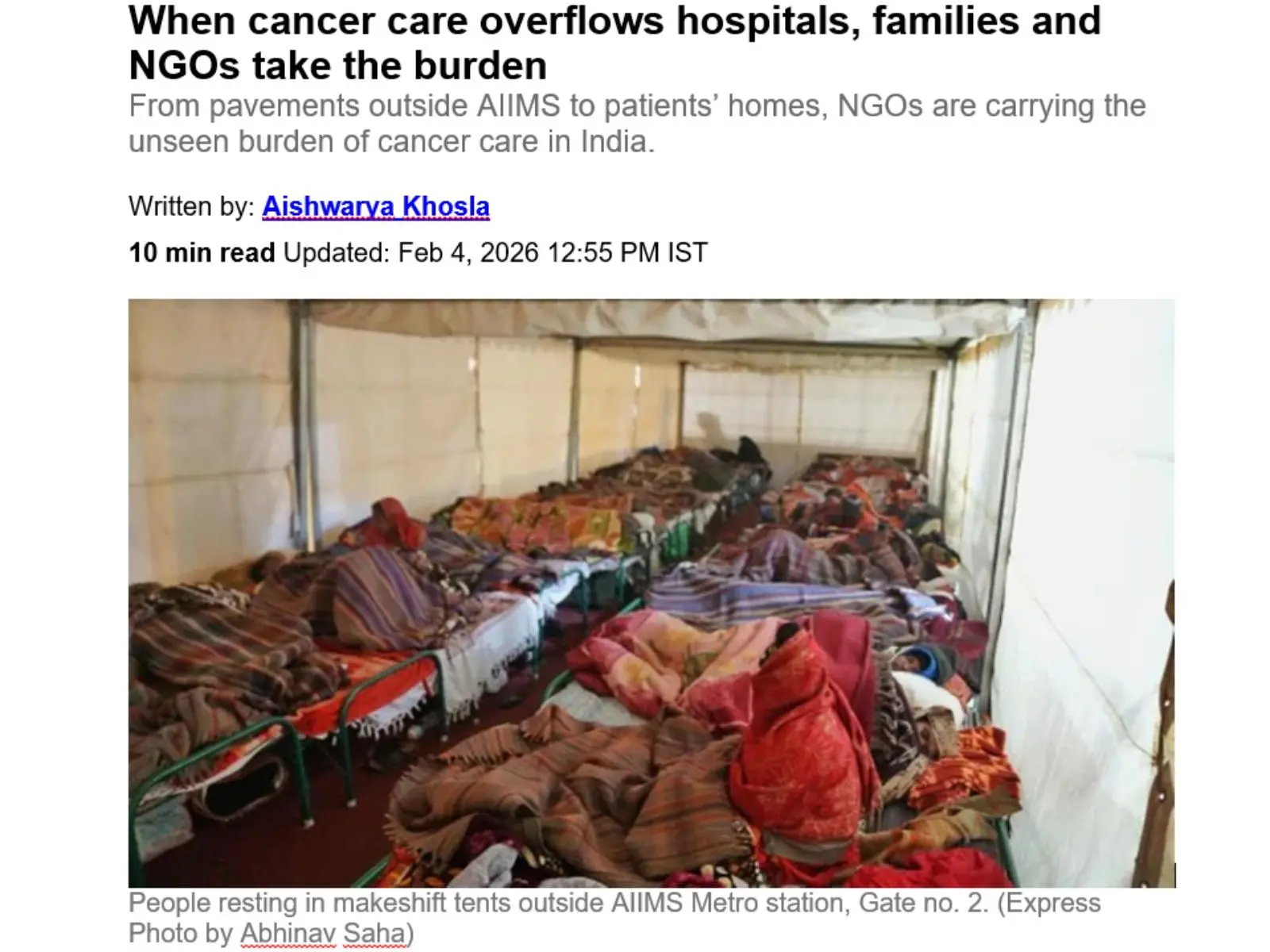
The Indian Express article examines how India’s cancer care system leaves critical gaps that hospitals alone are unable to bridge, particularly for patients diagnosed at advanced stages. As public hospitals remain overwhelmed and focused on clinical treatment, the responsibility for long-term care, emotional support, and daily survival increasingly shifts to families and non-governmental organisations.
Within this strained landscape, CanSupport emerges as a key organisation addressing what hospitals cannot consistently provide. The article positions CanSupport not as a substitute for medical treatment, but as a complementary system that supports patients and caregivers before, between, and beyond hospital visits.
Doctors quoted in the article underline this distinction clearly. Dr Sanjeev Sharma, oncologist at a private hospital in Bengaluru, explains that hospitals are structured primarily around curative interventions and acute care. Once aggressive treatment is no longer advised, he notes, sustained non-clinical support becomes difficult to deliver within hospital systems. This is where, he says, non-profit organisations play a crucial, complementary role by providing palliative and hospice care, pain management, catheter care, psychological counselling, and family support — services that hospitals cannot always offer comprehensively.
Echoing this view, Dr Bhawna Sirohi, cancer specialist and Medical Director at Balco Medical Centre, Raipur, highlights how organisations like CanSupport help close gaps across the cancer care continuum. She emphasises their role in awareness, screening, early detection, and ensuring continuity of care after screening, whether patients are referred to AIIMS, regional cancer centres, or non-profit hospitals.
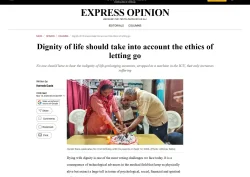
The article illustrates how CanSupport translates this gap-filling role into on-ground action. Through its day-care centres, patients and caregivers receive counselling, meals, essential supplies, and opportunities for social interaction — support that addresses emotional fatigue and isolation alongside medical needs. Beneficiaries describe these centres as spaces of relief amid long treatment journeys. One patient, Shakuntala Devi, captures this simply when she says, “Mann behel jaata hai,” describing how her mind finds distraction and comfort during time spent at the centre.
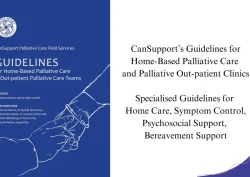
Beyond day-care facilities, CanSupport’s home-based palliative care programme is presented as a critical intervention. Multidisciplinary teams — comprising doctors, nurses, counsellors, and drivers — visit patients’ homes across Delhi-NCR and Pune. These teams respond during emergencies, manage pain, guide families through complex care needs, and reduce repeated hospital visits, allowing patients to remain in familiar surroundings.
For caregivers, this support is often transformative. Sonam Bhatia, who cares for her mother-in-law undergoing cancer treatment, explains that CanSupport provides both emotional and medical assistance, including access to expensive medicines. What stands out to her is the follow-up: phone calls checking on the patient’s condition, guidance on diet and exercises, and reassurance that questions will be answered. As she puts it, “They provide mental as well as medical support.”
The article also highlights how CanSupport recognises and responds to caregiver burnout, a recurring but often invisible consequence of prolonged caregiving. Ranjana Sethi, who oversees quality assurance for home-care services, describes regular evening calls to patients and caregivers — not as formal check-ins, but as conversations that invite people to share. She explains that simply listening often reveals distress early, allowing counsellors or medical professionals to step in when needed.
At an organisational level, Dr Ambika Rajvanshi, CEO of CanSupport, frames the work around dignity rather than cure alone. She states, “Quality of life means conforming to the real felt needs of patients and caregivers,” emphasising that care must address physical, emotional, functional, and social needs together. Her assertion that “we treat the person, not just the disease” reflects the organisation’s core philosophy.
Volunteers further reinforce this approach by rejecting pity-driven engagement. One volunteer, Deepti Banerjee, articulates this clearly when she says, “I don’t like the ‘bechari’ approach.” Instead, volunteering is rooted in respect, shared humanity, and meaningful interaction.
Through patient stories, expert voices, and lived experiences, the article ultimately shows that CanSupport addresses the invisible and unmet dimensions of cancer care— ensuring that patients and caregivers are supported not only medically, but emotionally and socially, even when formal healthcare systems are stretched to their limits.